How it works
How Does MemoPryl Work? The Four Ingredient Groups
MemoPryl combines four ideas in one capsule.
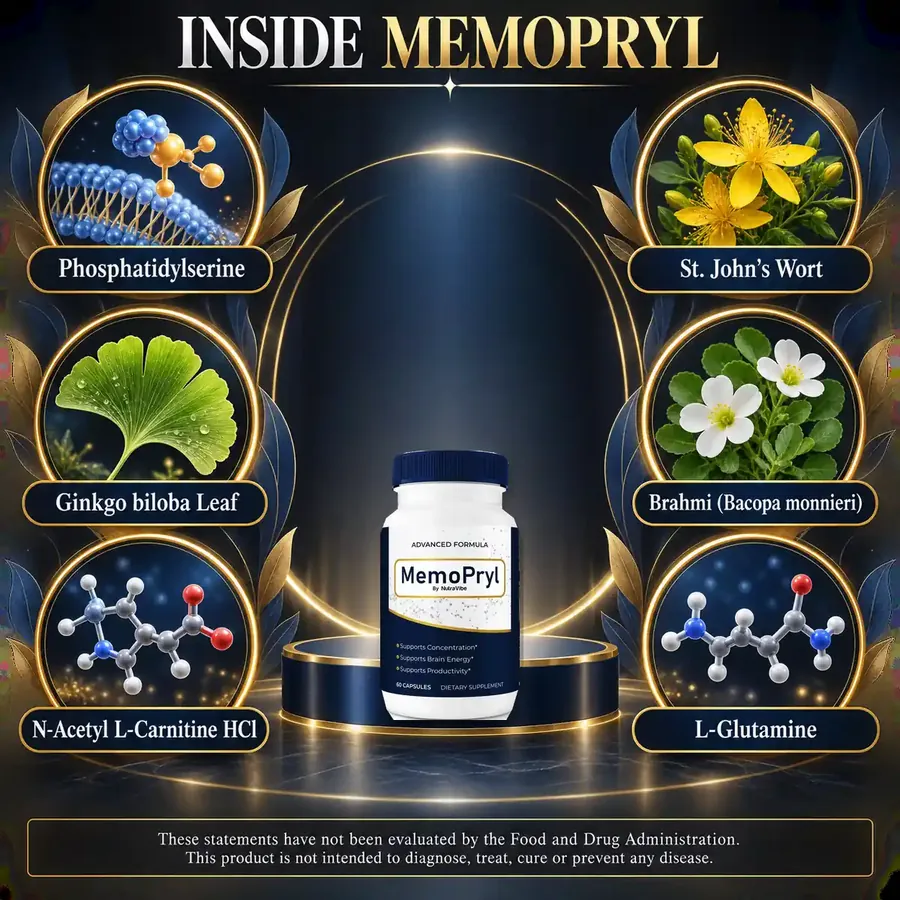
They are a membrane phospholipid (phosphatidylserine), three herbs (bacopa, ginkgo, St. John's wort), acetyl-L-carnitine for cell energy, and two acetylcholine-related compounds, alpha-GPC and huperzine A.
Each one has its own research. See what the label claims.
Written by the MemoPryl editorial teamUpdated
The brand's version
How is MemoPryl supposed to work?
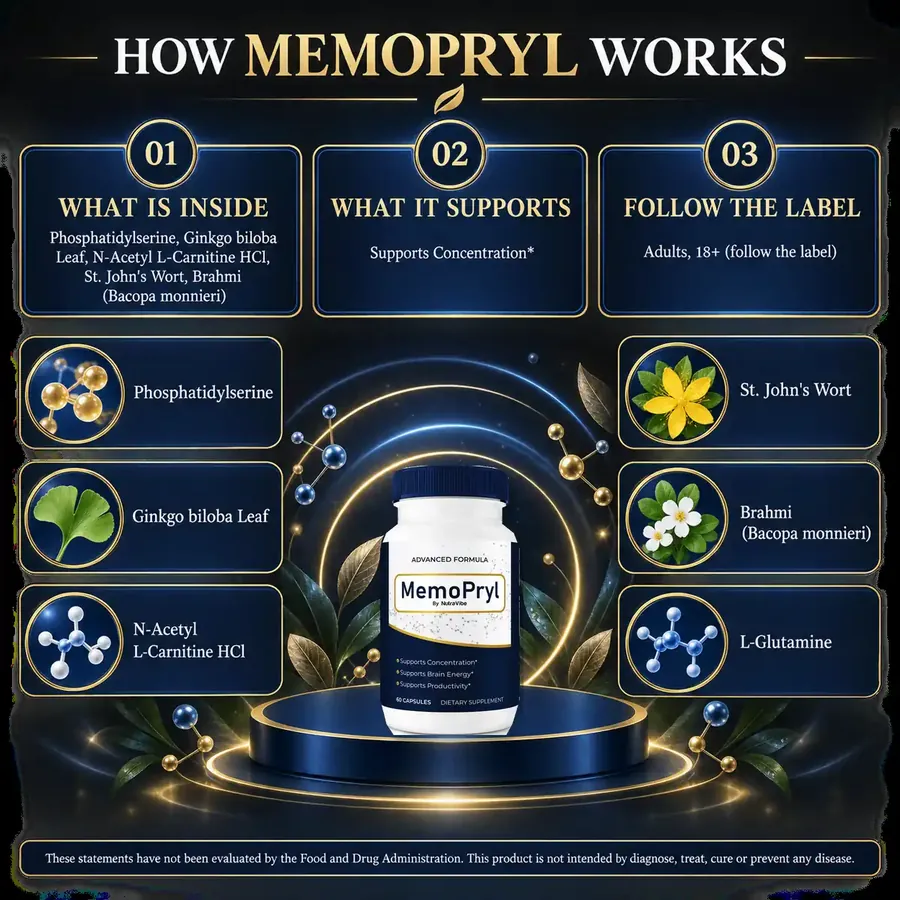
The brand's own explanation is three steps long. Its "How MemoPryl works" graphic lists what is inside, what it supports ("Supports Concentration") and "Follow the label" for adults 18+.
The graphic names the ingredients. It does not say how they act, how much of each is used, or how soon anything should happen. Public research can fill part of that gap, one ingredient at a time.
So each ingredient below is described by what independent sources say it does. None of those sources tested MemoPryl itself. For the label lines behind these names, see the MemoPryl label facts.
Four ideas
What does each ingredient group in MemoPryl do?
Each group rests on a different idea about the brain. L-glutamine, a common amino acid, sits outside all four.
Membrane phospholipid
Phosphatidylserine, a fat-like compound found in the membranes of brain cells. Sold to support memory.
Three herbs
Bacopa (brahmi), ginkgo leaf and St. John's wort. Only bacopa has memory trials that lean positive.
Carnitine
N-acetyl L-carnitine HCl, a carnitine form linked to cell energy. The closest match to the "Supports Brain Energy" claim.
Choline system
Alpha-GPC and huperzine A. Both relate to acetylcholine, a chemical messenger used in memory.
Phosphatidylserine
What is phosphatidylserine meant to do in MemoPryl?
It is meant to support memory by supplying a building block of brain cell membranes. The research gives it a small and uncertain role.
The Alzheimer's Drug Discovery Foundation summarizes a 2022 meta-analysis: phosphatidylserine "may have some potential benefit for memory." In small trials the effects were slight, "not large enough to be clinically relevant" (ADDF, Phosphatidylserine). Studies used 80 to 500 mg a day, and most lasted under six months.
Older trials used phosphatidylserine from cow brain. Today's supplements come from plant or marine sources, so not every early result carries over. The phosphatidylserine page covers its side effects.
The herbs
What are bacopa, ginkgo and St. John's wort meant to do?
Bacopa and ginkgo are sold for memory, while St. John's wort is best known for low mood. Only bacopa has results that lean positive, and they are small.
| Herb | Sold for | What the research found | Main caution |
|---|---|---|---|
| Bacopa (brahmi) | Memory | Many small trials; most found at least one small improvement, usually at 300 mg a day for about 3 months (ADDF, Bacopa) | Nausea, cramps; care with thyroid medicine |
| Ginkgo leaf | Memory | Three large studies found no drop in dementia risk (NCCIH, Ginkgo) | Bleeding risk with warfarin |
| St. John's wort | Low mood | Studied for mild to moderate depression; its source shows no memory evidence (NCCIH, St. John's wort) | Weakens many medicines |
The brand does not explain why a mood herb sits in a focus formula. That choice brings the biggest safety question in the bottle.
It can weaken birth control pills, warfarin, some antidepressants and many other medicines (NCCIH, St. John's wort). Taking any prescription? Ask a pharmacist before starting MemoPryl. Never stop or change a dose on your own.
Acetyl-L-carnitine
What does acetyl-L-carnitine do for the brain?
Carnitine helps cells carry fats into their energy centers, according to the NIH Office of Dietary Supplements. The acetyl form is the one tested in people with memory decline (NIH ODS, Carnitine).
A 2003 meta-analysis pooled 21 trials in 1,204 adults with mild cognitive impairment or mild Alzheimer's disease. At 1.5 to 3 grams a day for 3 to 12 months, scores improved. A later Cochrane review saw gains at 12 and 24 weeks, but not at 52. NIH concludes that routine clinical use is not justified.
The "Supports Brain Energy" wording on the NutraVibe bottle echoes this energy role. No study has measured brain energy from MemoPryl. More on the acetyl-L-carnitine page.
Ready to try MemoPryl?1 bottle $39.00 on the live listing · free standard shipping · 30-day returns
Order nowCholine and huperzine A
What is the choline idea behind alpha-GPC and huperzine A?
Both aim at acetylcholine, a messenger nerve cells use for memory and attention. Alpha-GPC supplies choline to build it, and huperzine A slows the enzyme that breaks it down.
Alpha-GPC
ADDF found no studies in healthy people. Dementia trials used 1,200 mg a day. Reported effects include heartburn, headache, insomnia, dizziness and confusion (ADDF, Alpha-GPC).
Huperzine A
From firmoss, it works much like most prescription Alzheimer's drugs. Small, short dementia trials used 200 to 400 mcg a day. A study of 84 healthy military personnel found no benefit (ADDF, Huperzine A).
It may add to the side effects of donepezil-type drugs, might lower heart rate and may worsen some epilepsy (ADDF, Huperzine A). If any of these apply to you, talk to your doctor first.
L-glutamine is a common amino acid. Memorial Sloan Kettering describes its use in cancer care and after surgery, not for memory, and notes it is not the same as glutamate (MSKCC, Glutamine).
Evidence meter
How strong is the research behind each MemoPryl ingredient?
The meter rates six ingredients alone for memory, from 0 to 5. MemoPryl as a whole gets no score, because it has no trial.
Doses
Why do the unknown amounts matter for how MemoPryl works?
Because research effects belong to doses. Without the Supplement Facts panel, nobody can check whether MemoPryl holds enough of anything to match the studies.
| Ingredient | Amount in research | Amount in MemoPryl |
|---|---|---|
| Bacopa | 300 mg a day (250-600 mg), about 3 months (ADDF, Bacopa) | Not published |
| Phosphatidylserine | 80-500 mg a day (ADDF, Phosphatidylserine) | Not published |
| Acetyl-L-carnitine | 1.5-3 g a day (NIH ODS, Carnitine) | Not published |
| Alpha-GPC | 1,200 mg a day, dementia trials only (ADDF, Alpha-GPC) | Not published |
| Huperzine A | 200-400 mcg a day, dementia trials only (ADDF, Huperzine A) | Not published |
With eight ingredients sharing each serving, some may sit well below research levels. Only the printed panel can settle it. Until then, follow the serving printed on your bottle.
Limits
Is MemoPryl a treatment for memory loss?
No. MemoPryl is a dietary supplement, and NCCIH finds no direct evidence that supplements prevent Alzheimer's disease or other dementias (NCCIH, Supplements for cognition).
If memory changes worry you, do not put off a doctor's visit. Some causes are treatable, and a supplement can delay finding them.
FAQ
How MemoPryl works: questions
Do the ingredients in MemoPryl work better together?
Nobody has tested that. No published trial of the MemoPryl formula was found, and the research cited here studies single ingredients at known doses. Mixing eight ingredients does not add their effects together, and it can add their side effects and interactions.
Why does MemoPryl have eight ingredients?
The brand graphics name six, and the eBay seller lists two more, alpha-GPC and huperzine A. Neither source explains the choice. Many ingredients let a label cover several ideas at once, but each one may then be present in a small amount.
What does alpha-GPC do in a memory supplement?
Alpha-GPC is a source of choline, which the body uses to make acetylcholine. ADDF found no studies in healthy people; trials in dementia used 1,200 mg a day (ADDF, Alpha-GPC). Whether MemoPryl contains it, and how much, depends on the version.
What is acetylcholine, and why does MemoPryl target it?
Acetylcholine is a chemical messenger nerve cells use for memory and attention. Two ingredients the eBay seller lists aim at it: alpha-GPC supplies choline, and huperzine A slows its breakdown. The brand graphics do not mention either compound or this idea.
Which MemoPryl ingredient has the strongest evidence?
Bacopa, though the bar is low. Many small trials found at least one small improvement, usually at 300 mg a day for about three months (ADDF, Bacopa). Phosphatidylserine and acetyl-L-carnitine follow with slight or mixed results. None of this research tested MemoPryl.
Does MemoPryl work like a prescription memory drug?
MemoPryl as a whole is a supplement, not a drug. One listed ingredient, huperzine A, works similarly to most prescription Alzheimer's drugs, according to ADDF (ADDF, Huperzine A). That overlap is why the huperzine note above matters for anyone already on such a drug.
Does MemoPryl contain caffeine?
Caffeine is not among the eight named ingredients. The other-ingredients line on the bottle has not been shown, so we cannot rule anything out there. If you avoid stimulants, read the full ingredient list on your own bottle.
Who wrote this
Written and reviewed by
Plain-language pages built from the label, the sales page and linked public health sources.
Last updated . Read our editorial standards and how we check reviews. This website is run by a U.S. stocking partner that sells MemoPryl, not by the maker (the pack shots say "By NutraVibe"). We earn money when you buy through our order links.
Keep reading
More about MemoPryl
Ingredients
All eight MemoPryl ingredient names, where each one comes from, and the two that need a medicine check.
Read more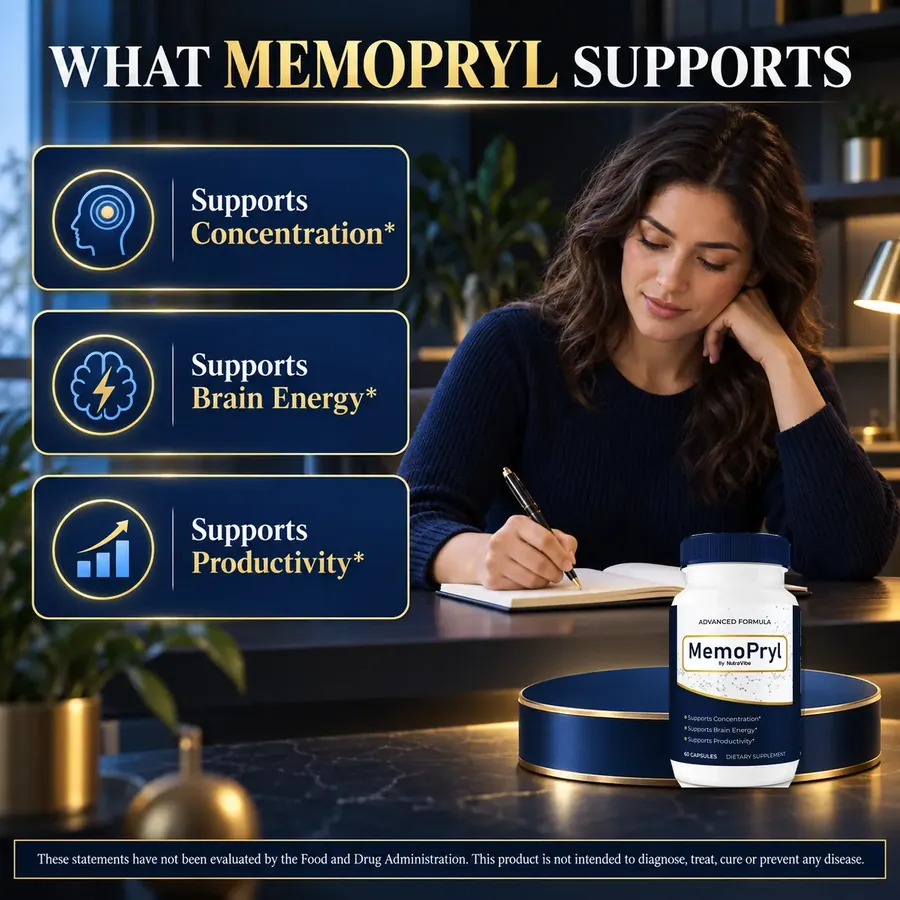
Benefits
The six MemoPryl label claims, each checked against the ingredient research, with a fair way to test them yourself.
Read more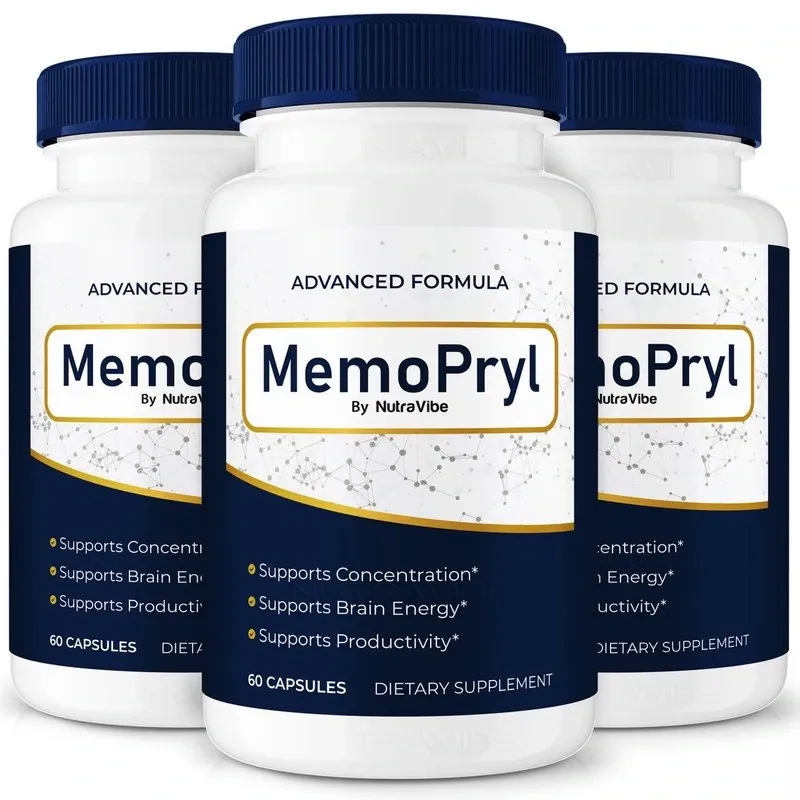
Results timeline
What the ingredient studies say about timing, a 30-day tracking plan, and when to see a doctor instead of waiting.
Read moreU.S. stocking partner for MemoPryl
Ready to try MemoPryl?
The live listing sells single 30-capsule bottles for $39.00 with free standard shipping and 30-day returns, the seller paying return postage.
- Secure checkout
- 30-day window
- Ships from the U.S. with tracking