Evidence check
Does MemoPryl Work? 5 Steps to Judge It Yourself
Nobody can say that MemoPryl works, because no study of the formula has been published and its amounts are not public. Some single ingredients show small effects at known doses. Use five steps: read the claims, weigh the studies, spot the dose gap, run a tracked 30-day test, then decide.
Written by the MemoPryl editorial teamMedically reviewed by Dr. James Bateman III, MD, MPH, PhysicianUpdated · 7 min read
Key facts
Key facts: what is known about whether MemoPryl works?
- No trial of the MemoPryl formula has been published, so there is no direct proof either way.
- The bottle claims are worded as "supports", "optimized" and "improves", each with an asterisk that leads to the FDA statement.
- Of its named ingredients, bacopa has the most consistent small memory results, usually at 300 mg a day for about 3 months (ADDF, Bacopa).
- Ginkgo did not lower dementia risk in three large studies (NCCIH, Ginkgo). St. John's wort was studied for mood, not memory (NCCIH, St. John's wort).
- The amount of each ingredient is not published, so nobody can say whether a capsule reaches a studied dose.
- No verified before-and-after photos or customer stories are published on this site.
Step 1
Step 1: What do the MemoPryl claims actually promise?
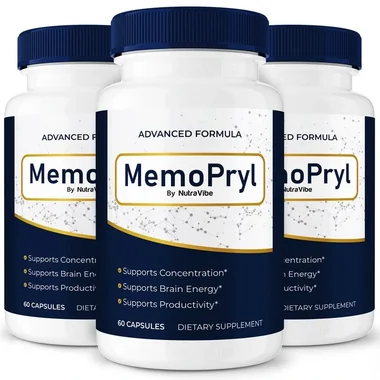
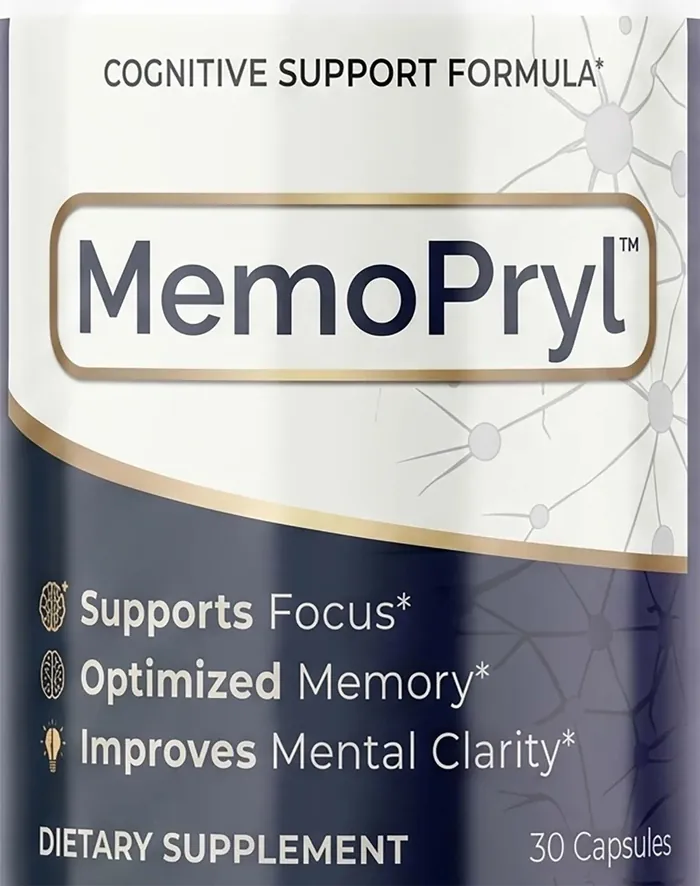
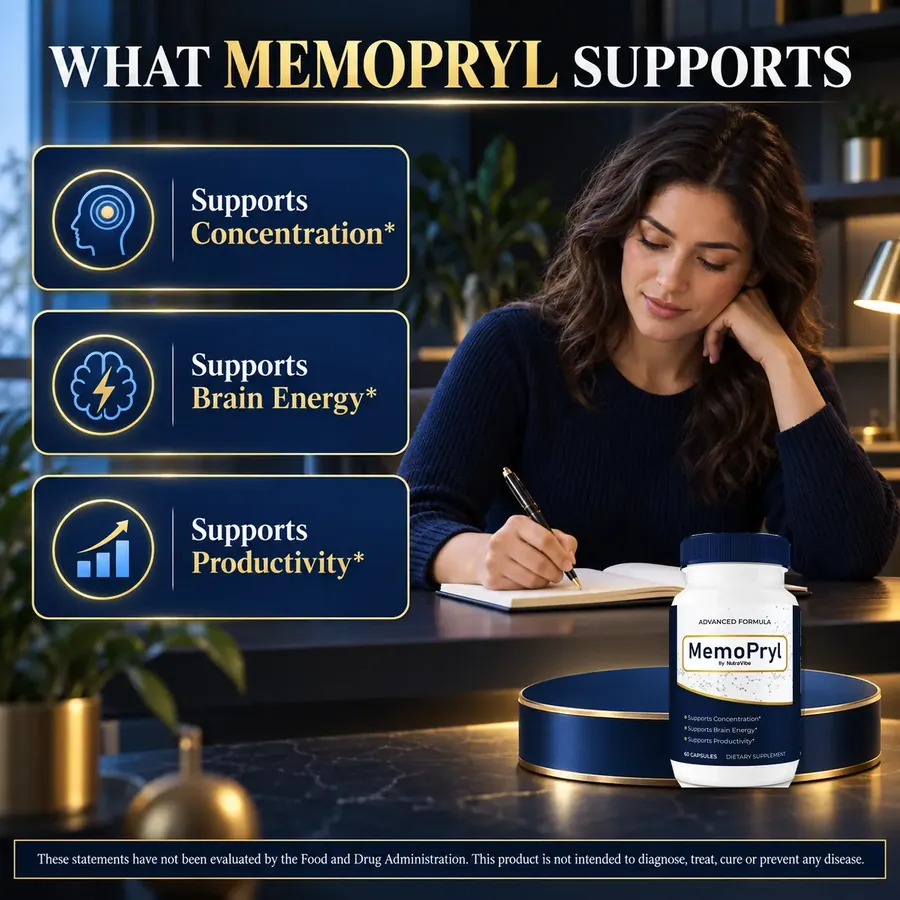
Start by reading the bottle the way a lawyer would. The 30-capsule label says "Supports Focus*", "Optimized Memory*" and "Improves Mental Clarity*". The 60-capsule label says "Supports Concentration*", "Supports Brain Energy*" and "Supports Productivity*".
The asterisk is the key. It points to a line saying the FDA has not evaluated the claim. A supplement may describe how it supports a body function, but it may not say it treats a disease. Neither bottle names a disease.
Words like "optimized" and "improves" sound more certain than "supports". Here, none of them is backed by a trial of the capsule. So the claims are a description of what the brand hopes for, not a record of what buyers got.
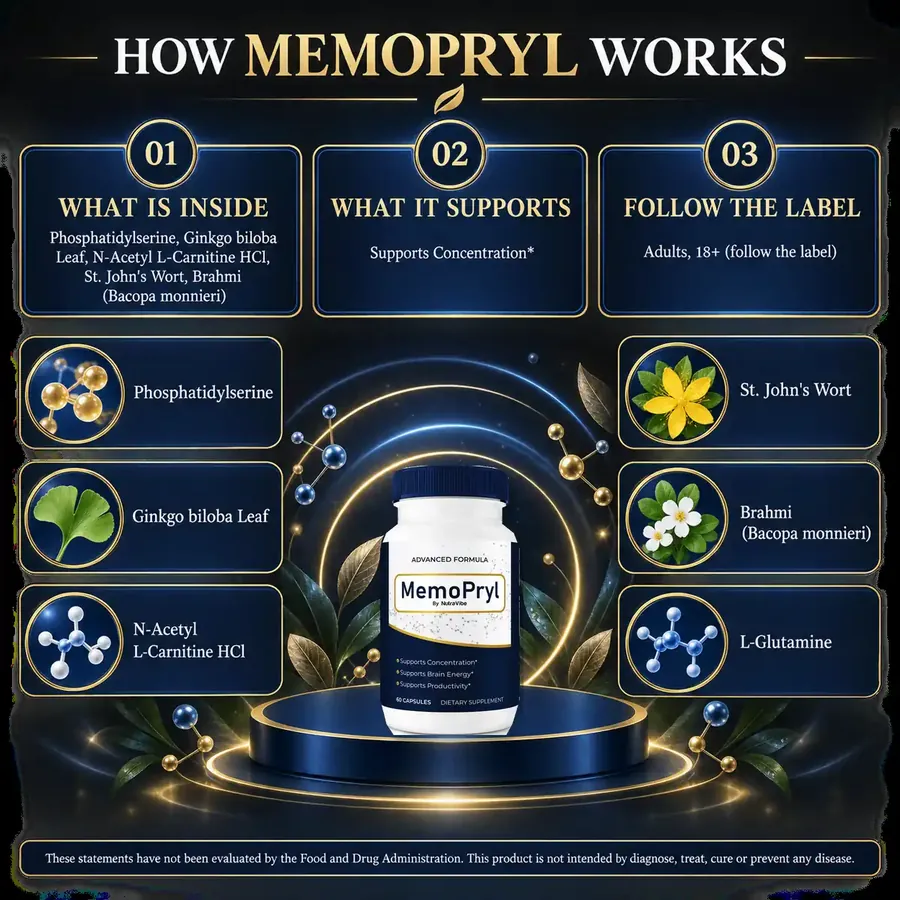
The question "how does MemoPryl work?" has a short, honest answer. The brand graphic lists what is inside, what it supports and a line to follow the label. It does not explain how any part acts.
Step 2
Step 2: What do the studies on each ingredient show?
Next, look at the research on each name on its own. These studies tested single ingredients at known doses, so they are the closest evidence we have.
| Ingredient | Who and how long | Outcome |
|---|---|---|
| Bacopa (brahmi) | Many small trials; usually 300 mg a day for about 3 months | Most found at least one small gain (ADDF, Bacopa) |
| Phosphatidylserine | 80-500 mg a day; most trials under 6 months | Slight effects, too small to matter clinically (ADDF, Phosphatidylserine) |
| Acetyl-L-carnitine | People with mild decline; 1-3 g a day | Better scores at 12 and 24 weeks, none at 52 (NIH ODS, Carnitine) |
| Ginkgo | GEM study: 3,000+ adults aged 75+, about 6 years | No drop in dementia risk (NCCIH, Ginkgo) |
| Huperzine A | Small dementia trials; 200-400 mcg a day | Small, high-bias trials; no benefit in 84 healthy military personnel (ADDF, Huperzine A) |
Two points stand out. Most volunteers already had memory problems, so healthy adults are rarely covered. And the best result is described as small. For the other effects, see our ingredients page.
Want to test it fairly?The listing allows returns for 30 days, which is enough to judge how a capsule suits you.
See today's price and guaranteeWe earn money when you buy through our order links.
Step 3
Step 3: Does MemoPryl reach the doses the studies used?
Nobody can tell. Neither label version has a published Supplement Facts panel, and the serving size is not published.
Think about the room in a capsule. Acetyl-L-carnitine trials used grams a day, and bacopa trials used hundreds of milligrams. Eight ingredients share one serving of MemoPryl. Some are likely to be far below study levels, but without the panel that is a guess, and we do not print guesses.
Message the eBay seller before you order and ask for a clear photo of the back of the bottle. You want the serving size, the amount of each ingredient and the warnings.
Step 4
Step 4: How do you run a fair 30-day test?
A month is shorter than most studies. Treat it as a test of how MemoPryl suits you, not as a test of everything it might do. These five habits make the result easier to trust.
Before the first capsule
Check the seal and the label version. Show the bottle to a pharmacist if you take any prescription. Read the serving on your own bottle.
Pick two measures
Choose things you can score in a minute, such as how long you can read before your mind drifts, and how many times a day you lose a word or an item.
Hold the basics steady
The CDC puts the adult sleep goal at 7 or more hours (CDC, Sleep) and activity at 150 minutes of moderate effort weekly (CDC, Activity). A change in either can mimic a capsule effect.
Log one line a day
Write the date, your two scores and any side effect. Memory of how you felt is unreliable, so use the page.
Decide by day 21
Compare week three with week one. If the numbers did not move or a side effect bothers you, start the return while the 30-day window is open.
Step 5
Step 5: When should you stop testing and see a doctor?
Right away if memory changes affect daily life, keep getting worse, or worry people close to you. Several causes can be treated, including medicine side effects, low vitamin B12 and depression (MedlinePlus, Memory loss). NCCIH advises against putting off a visit to try a supplement (NCCIH, Supplements for cognition).
Call 911 for sudden confusion, trouble speaking, weakness on one side, trouble seeing or walking, or a sudden severe headache. The CDC lists these as possible stroke signs (CDC, Stroke signs).
What supports giving it a try
- Small effects were seen for bacopa in single-ingredient trials
- A written return window lets you test it
- Claims avoid disease language
What argues for caution
- No trial of the formula
- No published amounts
- Energy, productivity and clarity were never measured in the studies we cite
FAQ
Frequently asked questions
Does MemoPryl really work?
We cannot say yes. No trial of the formula has been published, and its amounts are not public. Single ingredients such as bacopa show small effects at known doses, but MemoPryl may not reach those doses.
How does MemoPryl work?
The brand does not explain it. Its graphic lists the ingredients, the claims and a line to follow the label. Public research describes each ingredient on its own, and no source shows how they act together.
Is MemoPryl effective for memory?
Not shown. Some single ingredients, such as bacopa, helped on at least one memory test in small trials (ADDF, Bacopa). Ginkgo did not lower dementia risk in large studies (NCCIH, Ginkgo). No study measured MemoPryl itself.
Are there MemoPryl before and after results?
None that we can verify. This site shows no before-and-after photos, scores or customer stories until a real order is matched to each one. Be careful with any page that shows a dramatic change.
Can MemoPryl cure or treat dementia?
No. It is a dietary supplement, not a treatment for memory loss, dementia or Alzheimer's disease. NCCIH finds no direct evidence that supplements prevent dementia (NCCIH, Supplements for cognition). See a doctor about memory changes.
What if I notice nothing after 30 days?
That is a common outcome for products with small studied effects. Decide before day 30. If you want to stop, start the return in your eBay account while the 30-day window is open.
Bottom line
Our view
Our straight answer is that MemoPryl has not been shown to work, and it has not been shown not to. The evidence sits in single ingredients, mostly small, and the dose link to the bottle is missing.
That leaves you with a practical path. Read the claims as hopes. Weigh the studies as small. Test the capsule yourself for a month with a log, and keep sleep and activity steady so you can trust what you see.
If you see no change, return it. If memory worries you, skip the test and book a doctor's visit.
MemoPryl is a dietary supplement. It is not FDA approved, and no supplement is. It is not a treatment for memory loss, dementia or any disease. It contains St. John's wort, which can weaken many medicines. Ask your doctor or pharmacist before you start, and keep taking any prescribed medicine.
Last updated . Medically reviewed by Dr. James Bateman III, MD, MPH, Physician.
Sources
- Bacopa monnieri: Cognitive Vitality. Alzheimer's Drug Discovery Foundation, 2026.
- Ginkgo. National Center for Complementary and Integrative Health, 2026.
- St. John's Wort: Usefulness and Safety. National Center for Complementary and Integrative Health, 2026.
- Phosphatidylserine: Cognitive Vitality. Alzheimer's Drug Discovery Foundation, 2026.
- Carnitine: Fact Sheet for Health Professionals. NIH Office of Dietary Supplements, 2023.
- Huperzine A: Cognitive Vitality. Alzheimer's Drug Discovery Foundation, 2026.
- About Sleep. Centers for Disease Control and Prevention, 2024.
- Adult Activity: An Overview. Centers for Disease Control and Prevention, 2023.
- Memory loss. MedlinePlus Medical Encyclopedia, 2026.
- 7 Things To Know About Dietary Supplements for Cognitive Function, Dementia, and Alzheimer's Disease. National Center for Complementary and Integrative Health, 2026.
- Signs and Symptoms of Stroke. Centers for Disease Control and Prevention, 2026.
U.S. stocking partner for MemoPryl
A test, not a promise
One bottle is $39.00 on the live listing, with free standard shipping and 30-day returns. Use the plan above and keep your notes.
We earn money when you buy through our order links. MemoPryl is a dietary supplement and is not FDA approved.
Who wrote this
Written and reviewed by
Plain-language pages built from the label, the sales page and linked public health sources.
Last updated . Read our editorial standards and how we check reviews. This website is run by a U.S. stocking partner that sells MemoPryl, not by the maker (the pack shots say "By NutraVibe"). We earn money when you buy through our order links.